研究目的
To develop novel high-efficient red or far-red-emitting phosphors for phosphor-converted light-emitting diodes (pc-LEDs) for plant growth.
研究成果
A series of (BS)LZT:xMn4+ phosphors with double-perovskite structure were synthesized by SSR method. The structure of (BS)LZT is cubic belonging to the Fm-3m space group and Mn4+ may occupy the octahedral Ta5+ site based on structure refinement. The critical quenching concentration of Mn4+ is about 0.008 for both BLZT: xMn4+ and SLZT: xMn4+. The emission peak at 698 nm (695 nm) in the PL spectra. Under n-UV or blue light, the Mn4+ in BLZT and SLZT can emit far-red light peaking at 698 nm and 695 nm owing to the spin-forbidden 2Eg→4A2g transitions of Mn4+, respectively. The critical distance of (BS)LZT:xMn4+ phosphors was calculated to be 31 ? and the diploe-diploe interaction is contributed to concentration quenching mechanism of the Mn4+ centre. In addition, thermal quenching of (BS)LZT:xMn4+ phosphors is not very serious and SLZT:0.008Mn4+ (IT/I = 60%, 150 oC) shows better thermal stability than BLZT:0.008Mn4+ (IT/I = 40%, 150 oC) phosphors. Significantly, the IQE of (BS)LZT:0.008Mn4+ phosphor under 460 nm excitation reached as high as 80%. Finally, by combining BLZT:0.008Mn4+ and SLZT:0.008Mn4+ phosphors with blue InGaN chips, LED devices emit bright blue and red light. All these results indicate that far-red emission BSLZT: Mn4+ phosphors have potential application in high-power plant-growth LEDs.
研究不足
The PL intensity of (Ba,Sr)LaZnTaO6:xMn4+ phosphors decrease with increasing temperature. The SrLaZnTaO6:xMn4+ sample has better thermal stability than BaLaZnTaO6:xMn4+.
1:Experimental Design and Method Selection:
The (Ba,Sr)LaZnTaO6:xMn4+ phosphors were synthesized by the high temperature solid-state reaction (SSR) process. All raw materials were mixed by stoichiometric ratio and mixtures were calcined in air at 800 oC for 10 h and further heated at 1200 oC for 12 h.
2:Sample Selection and Data Sources:
Raw materials including SrCO3, BaCO3, MnCO3, ZnO, La2O3, and Ta2O5 were used without any further purification.
3:List of Experimental Equipment and Materials:
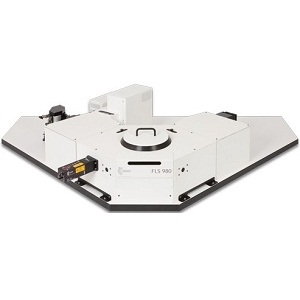
X-ray diffraction (XRD) data were obtained using a D8 Focus diffractometer (Bruker) with Cu-Kα radiation. X-ray photoelectron spectroscopy (XPS) spectrum was collected by a Thermo ESCALAB 250 instrument. The diffuse reflectance (DR) spectra were recorded by UV-visible diffuse reflectance spectroscopy UV-2550PC. The electron paramagnetic resonance (EPR) spectrum was obtained on a JES-FA 200 EPR spectrometer. Photoluminescence excitation (PLE) and emission (PL) at room temperature, photoluminescence (PL) spectra and luminescence decay curves were performed on an Edinburgh Instrument FLS-920 spectrometer with xenon lamp (450 W). Crystal grain of the (BS)LZT: Mn4+ was directly observed by a field-emission scanning electron microscope (FE-SEM). Lattice fringes is directly observed through Transmission electron microscopy (TEM). The photoluminescence quantum efficiency (IQE) was obtained by an absolute PL quantum efficiency measurement system C9920-
4:Experimental Procedures and Operational Workflow:
The fabricated of LEDs are combined with a 460 nm blue chip, representative red (BS)LZT: Mn4+ phosphor. The phosphors and the epoxy resins are mixed with continuous stirred for 15 mins. The mixture was coated on the surface of the 460 nm blue chip and dried at 120 oC to produce LED devices for further testing performance.
5:Data Analysis Methods:
The band-gap is calculated by the relationship of [hvF(R)]1/2 vs photon energy hv. The thermal quenching activation energy △E is expressed by the relationship of ln[(I0/IT)-1] versus 1/kBT.
独家科研数据包���,助您复现前沿成果���,加速创新突破
获取完整内容