研究目的
To present a simulation and experimental quasi-distributed Fabry–Perot optical fibre sensor for temperature measurements, aiming to provide theoretical results for a system made of 25 local sensors and experimentally test a system of nine local sensors.
研究成果
The paper concludes that the quasi-distributed Fabry-Perot optical fibre sensor system demonstrates high sensitivity and resolution for temperature measurements, with potential applications in dense sensing environments. The system's performance is validated through both simulation and experimental results, showing its effectiveness for multiplexed temperature sensing.
研究不足
The study acknowledges the impact of cross-talks on the sensor system's performance, although it is minimized by using weak reflectivity gratings and a broadband source. The resolution and sensitivity achieved are dependent on the robustness of the demodulation algorithm and the quality of the instruments used.
1:Experimental Design and Method Selection:
The study involves the design and simulation of a quasi-distributed FBG based Fabry-Perot sensor system using Matlab, followed by experimental testing of a sensor system consisting of 9 FBG based Fabry-Perot local sensors. The FT algorithm is used to measure temperature changes.
2:Sample Selection and Data Sources:
The local sensors are imprinted on a single array of the single mode fibre (SMF 28) using an Argon laser. The sensors are arranged in 3 distinct WDM channels.
3:List of Experimental Equipment and Materials:
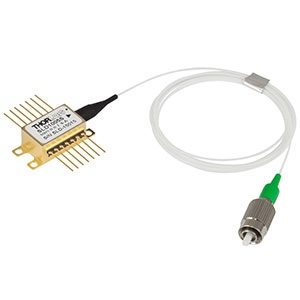
Includes a CW COVEGA Thor-Labs model SLD1005S super luminescent emitting diode (SLED) as the optical source, thermal plates for temperature changes, and power supplies for controlling temperature.
4:Experimental Procedures and Operational Workflow:
The experiment involves incrementing the voltage from the power supply to induce temperature changes, capturing the interference patterns, and applying the Fourier Transform algorithm for demodulation.
5:Data Analysis Methods:
The demodulation algorithm based on Fourier Transform shift analysis is used to evaluate temperature changes by analyzing phase shifts in the interference patterns.
独家科研数据包���,助您复现前沿成果��,加速创新突破
获取完整内容