研究目的
To propose and experimentally demonstrate a nonlinearity-compensation-free OFDR scheme based on electrically-controlled optical frequency sweep, aiming to reduce the complexity of optical structure and eliminate the difficulty of developing nonlinear phase compensation algorithm.
研究成果
The proposed OFDR scheme achieves high-resolution and high-SNR measurement without the need for nonlinear phase compensation, simplifying the optical structure and eliminating the difficulty of developing the nonlinear phase compensation algorithm. The spatial resolution and SNR are comparable to those achieved with commercial TLS and auxiliary interferometer with nonlinear phase compensation.
研究不足
The experimental setup requires precise control and alignment of the electro-optic frequency shifter and the direct digital synthesizer to achieve the desired linear frequency sweep. The performance may be affected by the quality and stability of the components used.
1:Experimental Design and Method Selection:
The scheme involves generating a linear frequency sweep light by propagating an ultra-narrow-linewidth continuous-wave light through an electro-optic frequency shifter, which consists of a dual-parallel Mach-Zehnder modulator and an electronic 90° hybrid, driven by a linear frequency modulated signal from a direct digital synthesizer.
2:Sample Selection and Data Sources:
The setup includes an ultra-narrow-linewidth fiber laser source, an electro-optic frequency shifter, and a direct digital synthesizer.
3:List of Experimental Equipment and Materials:
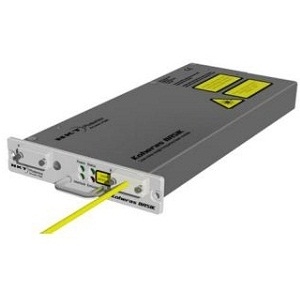
Ultra-narrow-linewidth fiber laser source (Koheras Basik E15, NKT Photonics), dual-parallel Mach-Zehnder modulator (COVEGA Mach-40086), electronic 90° hybrid (ABACUS MICROWAVE 9-010180, 1-18 GHz), and a home-made direct digital synthesizer.
4:Experimental Procedures and Operational Workflow:
The linear frequency sweep optical signal is divided into two branches, one entering the fiber under test via an optical circulator and the other propagating through a reference fiber, with the backscattered and reflected light recombined and detected by balanced photodetectors.
5:Data Analysis Methods:
The distributed information in the fiber under test is obtained through transforming the acquired time-domain signal to the frequency domain via fast Fourier transform (FFT).
独家科研数据包�����,助您复现前沿成果�,加速创新突破
获取完整内容