研究目的
Measuring the strongest optical coronal lines belonging to Fe X-XIV to provide accurate rest-frame wavelength data and benchmark the theory of complex open-3p-shell ions.
研究成果
Provided a consistent set of rest-frame wavelengths of transitions in several highly charged iron ions found in the solar corona and other astrophysical objects. The measurements are valuable for studies of the coronal heating problem, benchmarking atomic theory, and as a stepping stone towards optical clocks based on highly charged ions.
研究不足
The precision of wavelength determination is limited by the quality of the calibration and the Doppler broadening. Lower ion temperatures could improve precision but would reduce signal strength.
1:Experimental Design and Method Selection:
Employed electron beam ion traps (EBITs) to produce highly charged iron ions and grating spectrometers to obtain their spectra with improved precision.
2:Sample Selection and Data Sources:
Used iron atoms loaded as a molecular beam of Fe(CO)5, disassociated by the electron beam.
3:List of Experimental Equipment and Materials:
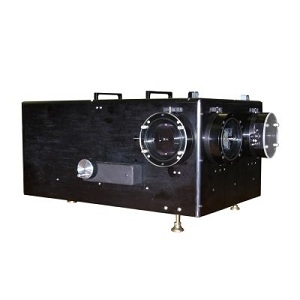
Utilized EBITs, grating spectrometers (Horiba Triax 550 and McPherson Model 2062), and hollow cathode lamps for calibration.
4:Experimental Procedures and Operational Workflow:
Recorded spectra at fixed grating angles, increased electron beam acceleration potential sequentially, and used calibration spectra for wavelength determination.
5:Data Analysis Methods:
Fitted Gaussians to the lines to determine their wavelengths and employed a Zeeman model line-shape function for precision measurements.
独家科研数据包�,助您复现前沿成果,加速创新突破
获取完整内容